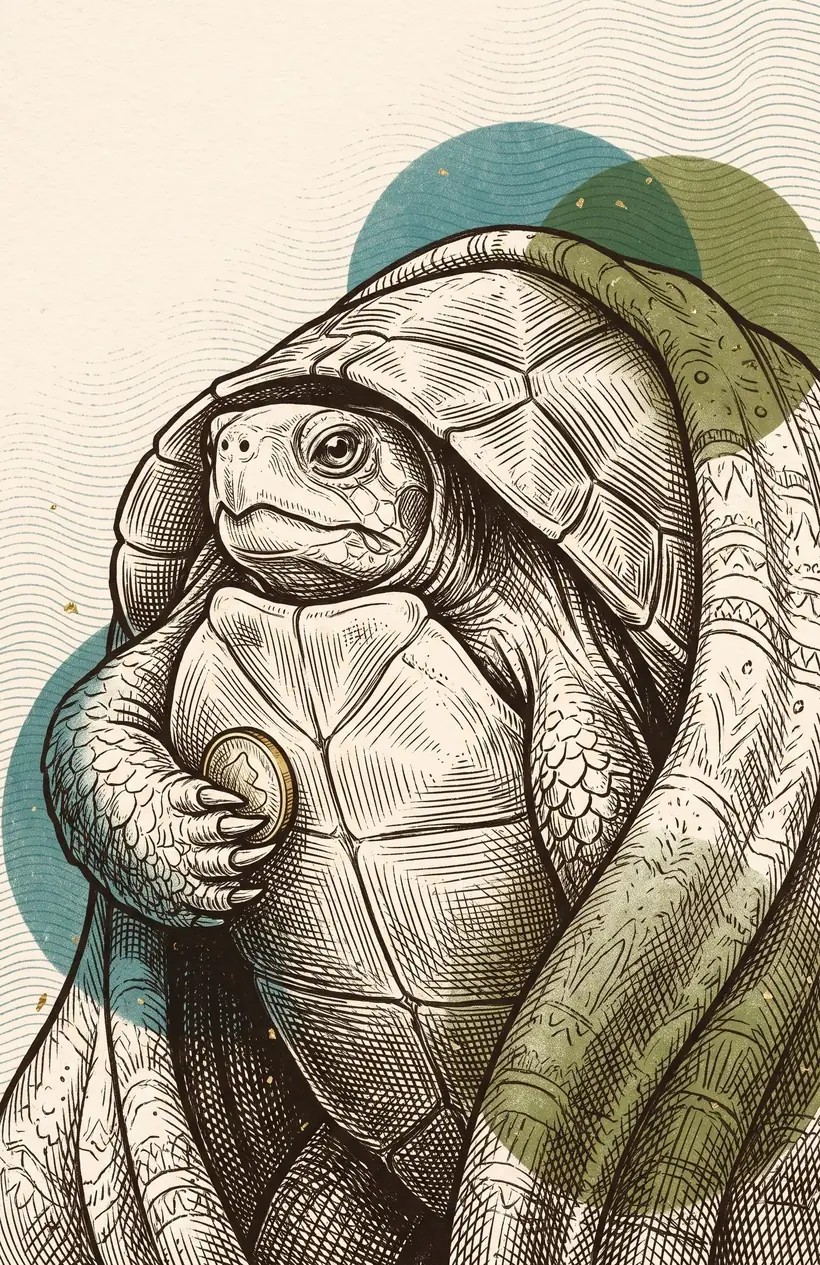
Your money animal
The Turtle
Ultra Risk-Averse
The Roast
Your money is very safe. It's also slowly getting smaller in a way you can't see. Cozy!
The pattern
Cash feels riskless but inflation quietly taxes it every year; avoiding all volatility guarantees the one loss you can predict. You're already great at dodging hype — a little steadiness is all it takes to dodge time, too.
Line Items
Very safe. Quietly shrinking. Cozy.
The Move
Learn one concept before acting: what an index fund is and why time-in-market beats timing.
No email needed — they have to guess yours first.
The Weekly Receipt · First Edition · Nº 11 / 12
The Appraisal · rare · Nº 11
The Turtle
Ultra Risk-Averse
If you keep everything in cash because investing scares you, The Weekly Receipt calls you the Turtle. Everything in cash, terrified of loss, misses the growth.
Your money is very safe. It's also slowly getting smaller in a way you can't see. Cozy!
A pattern, not a verdict — and if this is survival right now, not habit, the roast isn’t for you; the next step still is.
Exhibit 01
The pattern underneath
Cash feels riskless but inflation quietly taxes it every year; avoiding all volatility guarantees the one loss you can predict. You're already great at dodging hype — a little steadiness is all it takes to dodge time, too.
Exhibit 02
Why all-cash quietly shrinks
Keeping everything in cash feels like the one choice on the whole board with no downside attached, and that comfortable feeling is exactly the trap. A savings balance never once shows a loss on the screen, so the brain happily files it away as risk-free — but "the number didn't drop" and "the money held its value" are two genuinely different claims wearing the same coat. What cash quietly loses is buying power: prices drift up a little every year, and the same untouched balance simply buys less and less over time, a real loss that never appears as a red number anywhere you'd ever think to look.
The wiring underneath it all is loss aversion — the well-studied finding that a loss tends to sting more than an equivalent gain feels good. So a visible dip in an investment reads as flatly intolerable, while the invisible, safe-feeling, year-after-year erosion of cash barely registers as anything at all, even though stretched over a decade it's comfortably the more certain drain of the two. You're not being irrational here; you're simply responding to the risk you can plainly see and quietly ignoring the one you can't — which happens to be the exact swap this whole pattern makes on your behalf.
It's genuinely worth naming what the caution gets right, because it's a great deal. You're categorically not the one gambling the rent on a hot tip from a group chat, or panic-selling everything at the very bottom — dodging hype is a real and rare strength, and it reliably protects you from the flashy, expensive mistakes that routinely wreck bolder temperaments. The gap here isn't some recklessness you urgently need to go develop. It's that avoiding every visible risk quietly locks in the one invisible risk, so flawless safety on the one axis you can see becomes a slow, predictable shortfall on the axis you can't.
The sheer scale of the hesitation is far bigger than it ever feels from inside your own head, which is oddly and genuinely reassuring — you are standing in an enormous crowd. When you combine every possible way of owning stock, direct and indirect together, a striking share of families turn out to own precisely none of it, not even quietly through a workplace retirement account. Sitting entirely in cash isn't some rare, private failure of nerve you should feel singled out by; it's an extremely common starting point, which also means the well-worn path off it doesn't require becoming a whole different kind of person.
So the fix was never bravado — it's one boring concept understood well enough that a small, measured step stops feeling anything like a bet. Learn what an index fund actually is (a low-cost basket of the entire market) and why time spent in the market tends to quietly beat trying to cleverly time your way in and out of it — understanding first, always, and only then a tiny automatic amount, kept small enough that an ordinary dip wouldn't rattle you in the slightest. Steadiness, not daring, is the thing that quietly closes the long gap between merely feeling safe and actually being safe.
The number to know
42%
Combining direct and indirect holdings, 58% of U.S. families own stock — which means about 42% own none at all, not even inside a retirement account (in the bottom half of incomes, roughly two-thirds own none) — so all-cash is common, not a personal flaw.
Exhibit 03
What the Turtle gets right
Exhibit 04
Your next moves
- Learn one concept before acting: what an index fund is and why time-in-market beats timing.
- Start stupidly small — understanding first, then a tiny automatic amount.
This is the general read
Want your version — your real score spectrum, your primary + shadow blend, and the tension your own answers reveal? That takes two minutes.
Questions people ask about the Turtle
- Why do I keep everything in cash because investing scares me?
- Cash feels riskless but inflation quietly taxes it every year; avoiding all volatility guarantees the one loss you can predict. You're already great at dodging hype — a little steadiness is all it takes to dodge time, too.
- Is being the Turtle a bad thing?
- No — it's a pattern, not a verdict. Turtles tend to be careful, never reckless, great at not losing money to hype. The goal isn't to stop being you; it's to manage the one habit that quietly costs you.
- How do I work on being the Turtle?
- Learn one concept before acting: what an index fund is and why time-in-market beats timing. Start stupidly small — understanding first, then a tiny automatic amount.
Guides for the Turtle
When saving turns into never spending
If you have savings but flinch every time you spend, you're not irresponsible — you're over-correcting. Spending less than you'd like is more common than overspending, and the fix is a small, named amount that's yours to enjoy on purpose.
Read the guideScared to invest: why you freeze (and the stupidly small first step)
Being scared to invest isn't ignorance — it's loss aversion doing exactly its job: losses feel about twice as big as gains, so the freeze is your brain protecting you. The fix isn't courage. It's understanding the mechanism, then starting stupidly small.
Read the guideMeet more money animals
Just so we’re clear: The Weekly Receipt is financial education and entertainment, not personalized financial, investment, tax, or legal advice. Your money animal is a fun framework, not a diagnosis. This read and its cited number were reviewed by The Weekly Receipt.