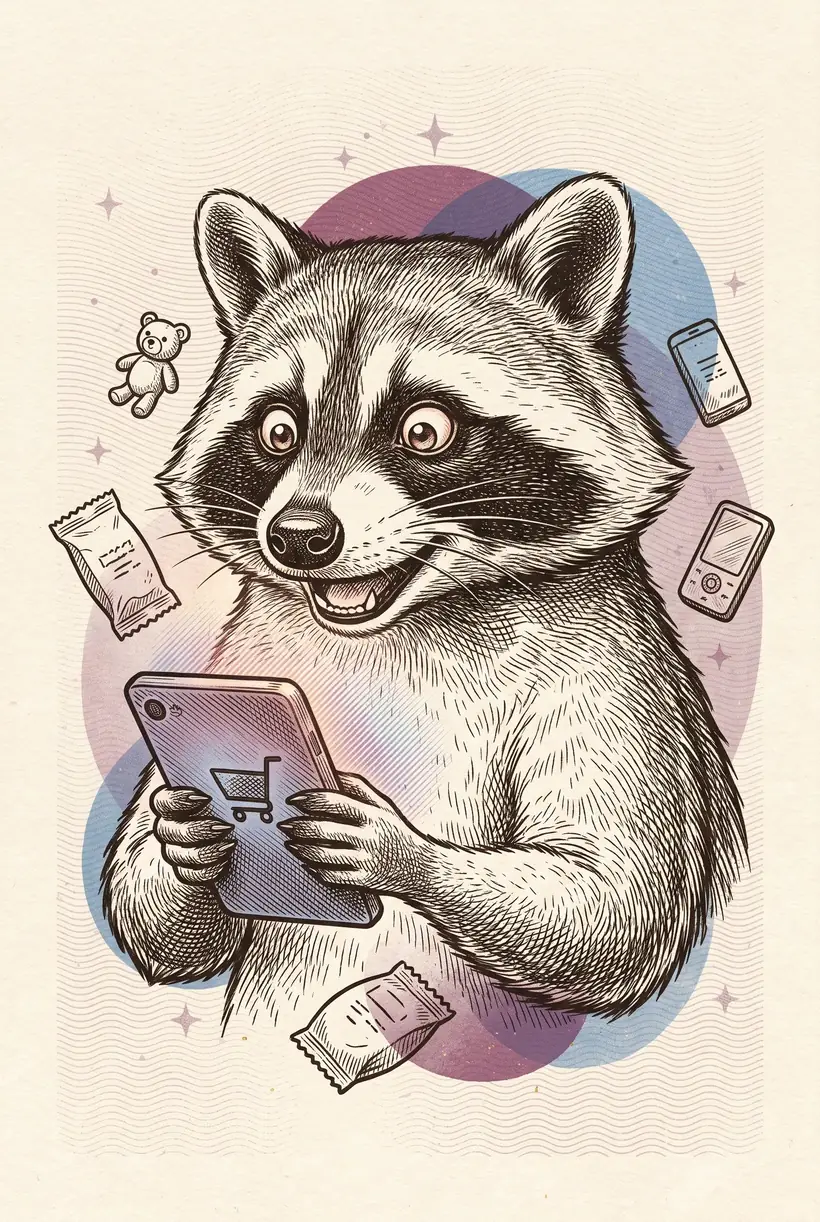
Your money animal
The Raccoon
Late-Night Impulse
The Roast
You'd never overpay for anything — except at 1am, emotionally, in a cart you'll regret by breakfast.
The pattern
Impulse spending spikes when you're tired, bored, or feeling something; the purchase is mood-regulation wearing a shopping outfit.
Line Items
1am has your card memorized.
The Move
Add friction where it counts: delete saved cards from your phone; make 1am-you type the numbers in.
No email needed — they have to guess yours first.
The Weekly Receipt · First Edition · Nº 12 / 12
The Appraisal · epic · Nº 12
The Raccoon
Late-Night Impulse
If you impulse-shop late at night, The Weekly Receipt calls you the Raccoon. Deal-hunter by day, 1am cart-filler by night.
You'd never overpay for anything — except at 1am, emotionally, in a cart you'll regret by breakfast.
Exhibit 01
The pattern underneath
Impulse spending spikes when you're tired, bored, or feeling something; the purchase is mood-regulation wearing a shopping outfit.
Exhibit 02
Why 1am is the danger hour
The very same person who compares prices for a solid week and flatly refuses to overpay by a single dollar will, at 1am, calmly fill an entire cart on pure feeling alone — and it genuinely isn't a contradiction, it's a different brain quietly running the late shift. Self-control is a finite resource that drains steadily across the whole day, and by the small hours the careful, price-checking, deal-hunting part of you has clocked off and gone to bed. What's left wide awake is the part that just wants to feel better right now — and that's a completely different shopper, working from a completely different budget.
That's because the late-night purchase usually isn't really about the object sitting in the cart at all — it's mood regulation wearing an unconvincing shopping outfit. Tired, bored, quietly wired, or a little low: the cart becomes a fast, reliable, dependable way to feel a small flicker of control or anticipation on an evening where the day itself never bothered to deliver any. The actual item is very nearly incidental to the whole transaction; what you're truly buying is a two-minute shift in how you feel, which is precisely why it can feel so urgent at midnight and so genuinely baffling by breakfast.
Night is, conveniently and cruelly, the exact hour when every single safeguard you own is at its very weakest, all of them at once. Willpower is fully depleted, the house has gone completely silent, and the natural friction that reliably stops a daytime purchase — a second opinion from a friend, a genuinely busy schedule, the plain sobering light of day — has all quietly gone to bed alongside everyone else. Meanwhile the phone in your hand has stripped out nearly every remaining speed bump there ever was: saved cards and one-tap checkout mean the gap between the raw feeling and the finished, confirmed order is now roughly four seconds wide.
It genuinely helps to see clearly just how ordinary all of this is, because the private 1am version of it can feel like a personal glitch unique to you. A large share of adults readily describe themselves as emotional spenders, and among the younger ones a genuinely striking number admit the real bulk of it happens right there in bed — the precise scene you already know far too intimately well. The pattern isn't some quiet flaw buried in your character; it's an entirely predictable collision between a tired brain, a low or restless mood, and a checkout button deliberately engineered to be as frictionless as physically possible.
So the fix was never going to be summoning more willpower at the single worst possible hour to summon it — it's to physically put the friction back exactly where the phone quietly removed it, in advance, while daytime-you is still the one holding the controls. Delete the saved cards so that 1am-you actually has to hunt down and type the long number in by hand, and give the feeling a different exit than the cart altogether: a firm 20-minute wait on anything over a set amount, just long enough for the mood to move on and for tomorrow-you to finally get a vote. You're not white-knuckle fighting the urge; you're simply slowing it down until it quietly passes on its own.
The number to know
39%
39% of Americans identify as emotional spenders, and nearly a quarter of Gen Z (24%) and millennials (21%) say they do most of that spending from bed — the 1am cart is a common coping reflex, not a personal glitch.
Exhibit 03
What the Raccoon gets right
Exhibit 04
Your next moves
- Add friction where it counts: delete saved cards from your phone; make 1am-you type the numbers in.
- Give the feeling a different exit — a 20-minute wait rule on anything over $30.
This is the general read
Want your version — your real score spectrum, your primary + shadow blend, and the tension your own answers reveal? That takes two minutes.
Questions people ask about the Raccoon
- Why do I impulse-shop late at night?
- Impulse spending spikes when you're tired, bored, or feeling something; the purchase is mood-regulation wearing a shopping outfit.
- Is being the Raccoon a bad thing?
- No — it's a pattern, not a verdict. Raccoons tend to be great at finding deals, spontaneous and fun, self-aware. The goal isn't to stop being you; it's to manage the one habit that quietly costs you.
- How do I work on being the Raccoon?
- Add friction where it counts: delete saved cards from your phone; make 1am-you type the numbers in. Give the feeling a different exit — a 20-minute wait rule on anything over $30.
Guides for the Raccoon
Meet more money animals
Just so we’re clear: The Weekly Receipt is financial education and entertainment, not personalized financial, investment, tax, or legal advice. Your money animal is a fun framework, not a diagnosis. This read and its cited number were reviewed by The Weekly Receipt.