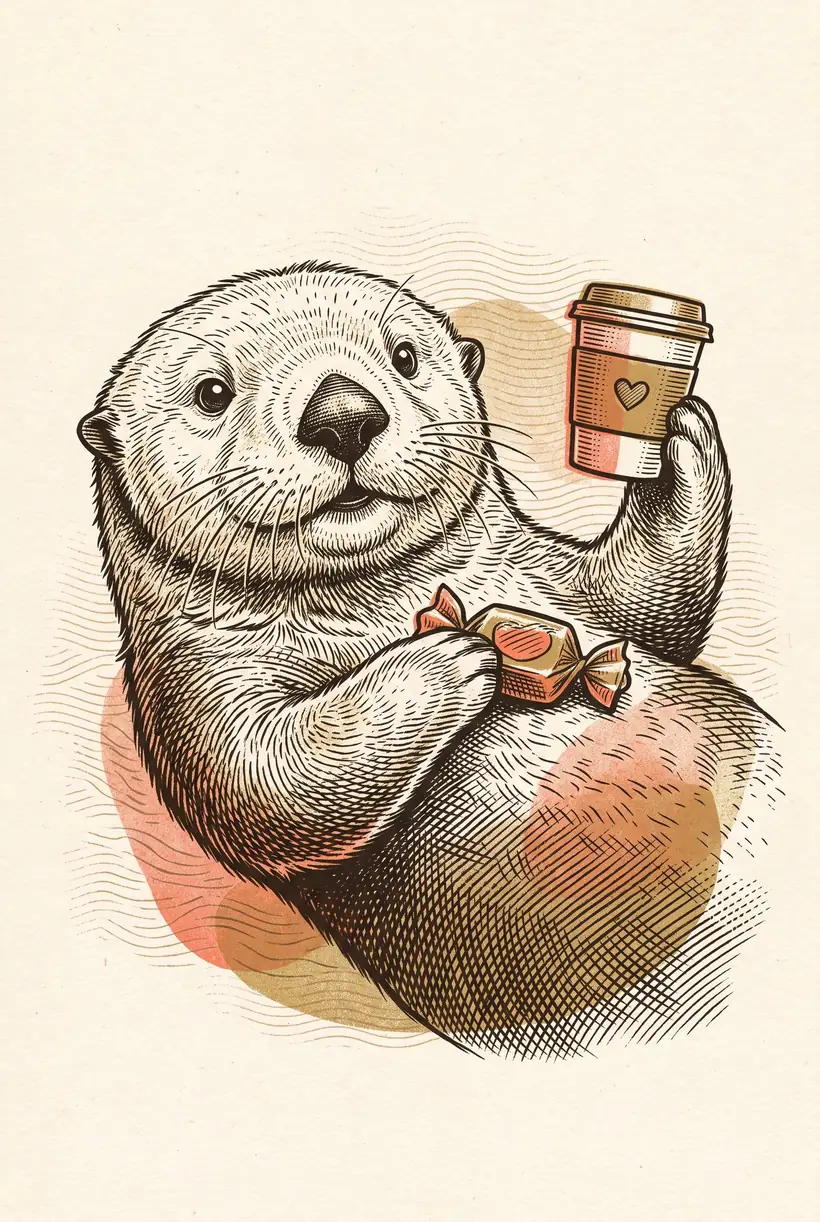
Your money animal
The Otter
Treat-Yourself Philosopher
The Roast
Your money isn't disappearing. It's leaving in small, dramatic exits every day.
The pattern
Tiny purchases slip past the part of your brain that flinches at big ones — so 40 little “treats” never feel like the $340 they quietly become.
Line Items
A thousand tiny, joyful exits.
The Move
Don’t budget yet — just witness. For 7 days, text yourself every purchase under $15.
No email needed — they have to guess yours first.
The Weekly Receipt · First Edition · Nº 01 / 12
The Appraisal · common · Nº 01
The Otter
Treat-Yourself Philosopher
If you spend money on small things, The Weekly Receipt calls you the Otter. Small, delightful, constant purchases. Joy now, math later.
Your money isn't disappearing. It's leaving in small, dramatic exits every day.
Exhibit 01
The pattern underneath
Tiny purchases slip past the part of your brain that flinches at big ones — so 40 little “treats” never feel like the $340 they quietly become.
Exhibit 02
Why small treats slip the net
Big purchases set off an alarm. Your brain treats a $600 hit as a real event — it flinches, it stalls, it makes you sleep on it. A $6 hit trips nothing. It lands below the line where the brain bothers to keep score, so "it's only a coffee" is true in the moment and true again tomorrow afternoon, and the two are never added together. The purchases were never the problem. The not-adding is.
Behavioral economists have a name for the wiring: mental accounting — we sort money into separate mental envelopes and almost never total across them. A treat gets its own tiny envelope, spent and closed, forty times a month. Each one really is small. The sum is the part your brain refuses to hold, which is exactly why the month-end number arrives as an ambush instead of a decision you remember making.
There's a feelings layer under the math, too. The reach is usually doing a real job — a quick lift when the day goes sideways, a small dependable vote that you're okay. That's the good news hiding in the mechanism: this isn't a discipline flaw, it's a counting flaw attached to a coping tool that mostly works. It also explains why crackdowns backfire — pull the treats cold and you've yanked a regulator without replacing it, so the spending snaps back louder than before.
So the honest move isn't wanting less; it's seeing more. Make the small exits countable — a running tally your brain won't keep on its own — and the delight stays while the surprise disappears. That's the on-ramp below. The deeper, personalized version of this pattern — where yours tips under stress, and a full plan to keep the joy and close the leak — is what the Full Read is for.
The number to know
42%
42% of Americans go shopping to treat themselves at least once a month, and 21% do it at least once a week — so the habit is ordinary, not a personal failing.
Exhibit 03
What the Otter gets right
Exhibit 04
Your next moves
- Don’t budget yet — just witness. For 7 days, text yourself every purchase under $15.
- Give joy a lane: one small automatic “treat fund” so delight has a home instead of a leak.
This is the general read
Want your version — your real score spectrum, your primary + shadow blend, and the tension your own answers reveal? That takes two minutes.
Coming — the Full Read
Go past the card — the full pattern under your money.
The card gave you the top layer. The Full Read is the mechanism underneath: why you reach, where you tip under stress, and a plan that keeps the joy and closes the leak.
What’s inside
- Why you reach — the mechanism under the small stuff
- Your four dials: what each one costs you, and buys you
- Where you tip under stress, and how to catch the swing
- Four weekly moves that keep the joy and close the leak
- What to say to a partner, a friend, and yourself
- When it isn't a habit — and where real help lives
Free preview
The pattern under the pattern
The free card told you the truth, but only the top layer of it: a handful of $6 treats slips past the alarm that a single $600 purchase would trip. That's the symptom. The real move is why you reach at all — and it's almost never about the thing. The treat is a small, dependable hit of choosing yourself: a two-minute lever you can pull when the day goes sideways. The coffee, the upgrade, the second app. Each one is a quiet vote that you're fine.
$9 founding price
Reserving is free — nothing is charged today, and no card is asked for. Founding readers are how this gets made: you get first access at the founding price when it ships, and one reply cancels your spot.
The Full Read is general money education and entertainment, not personalized financial advice. It reads common habits — it is not an assessment of your finances — and it promises clarity and a next step, never a specific financial outcome. For decisions about your situation, talk to a qualified professional.
Questions people ask about the Otter
- Why do I spend money on small things?
- Tiny purchases slip past the part of your brain that flinches at big ones — so 40 little “treats” never feel like the $340 they quietly become.
- Is being the Otter a bad thing?
- No — it's a pattern, not a verdict. Otters tend to be finds genuine joy in money, generous, never a doom-and-gloom hoarder. The goal isn't to stop being you; it's to manage the one habit that quietly costs you.
- How do I work on being the Otter?
- Don’t budget yet — just witness. For 7 days, text yourself every purchase under $15. Give joy a lane: one small automatic “treat fund” so delight has a home instead of a leak.
Guides for the Otter
Why you overspend (and the 7-day fix that isn't a budget)
Overspending is usually about timing and emotion, not willpower. Start by witnessing — not restricting — your small daily purchases for one week.
Read the guideWhy couples fight about money (it's the styles, not the math)
Couples don't fight about money — they fight about what money means. A saver married a spender, each one's coping style reads as recklessness or stinginess to the other, and the same fight repeats because it was never about the number.
Read the guideMeet more money animals
Just so we’re clear: The Weekly Receipt is financial education and entertainment, not personalized financial, investment, tax, or legal advice. Your money animal is a fun framework, not a diagnosis. This read and its cited number were reviewed by The Weekly Receipt.