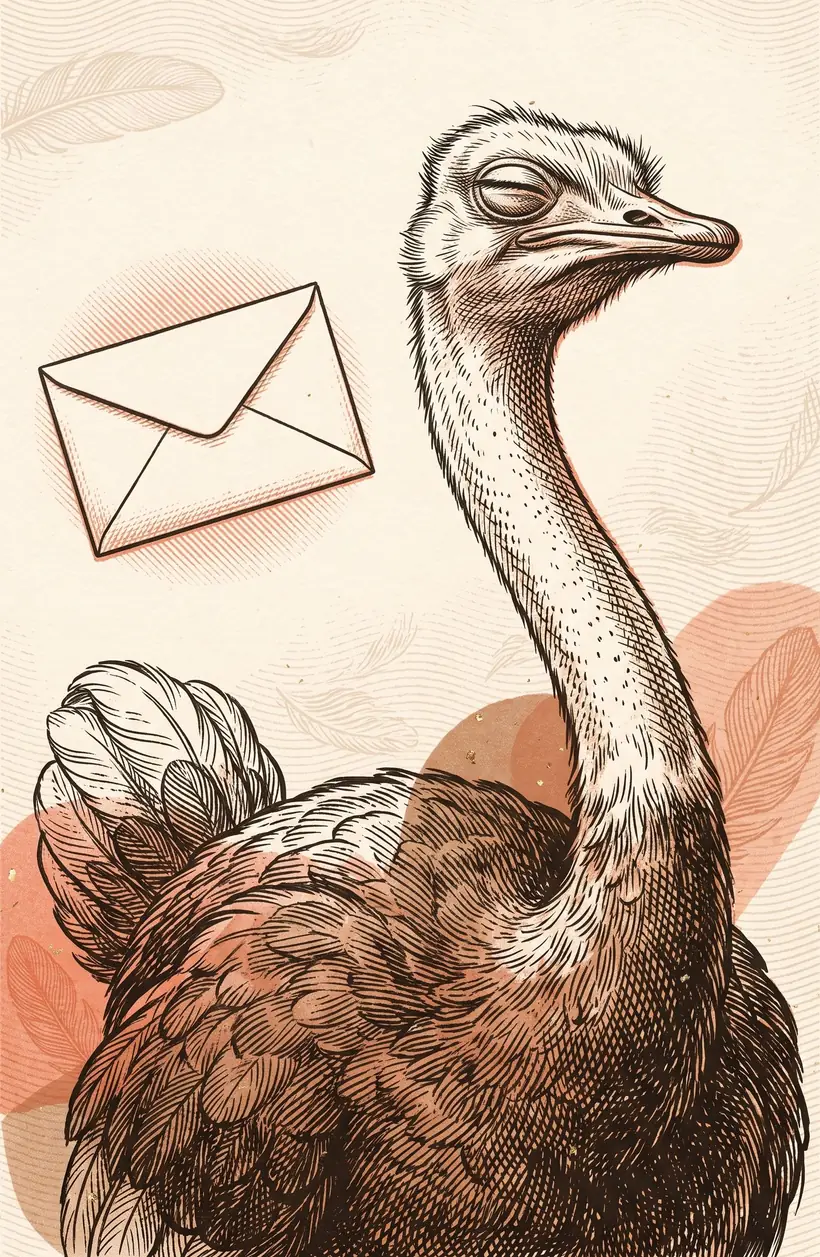
Your money animal
The Ostrich
Financial Avoider (fear)
The Roast
Your financial plan is to not look, and to be pleasantly surprised. How's that going?
The pattern
Avoidance is an anxiety-management strategy, not laziness — not knowing feels safer than maybe-bad-news. The relief is real but temporary; the cost compounds.
Line Items
Hope is doing the bookkeeping.
The Move
The 5-minute money date: once a week, just look. No fixing, no budget. Looking is the whole assignment.
No email needed — they have to guess yours first.
The Weekly Receipt · First Edition · Nº 05 / 12
The Appraisal · common · Nº 05
The Ostrich
Financial Avoider (fear)
If you avoid checking your bank account, The Weekly Receipt calls you the Ostrich. Won't check the balance; hopes really hard instead.
Your financial plan is to not look, and to be pleasantly surprised. How's that going?
A pattern, not a verdict — and if this is survival right now, not habit, the roast isn’t for you; the next step still is.
Exhibit 01
The pattern underneath
Avoidance is an anxiety-management strategy, not laziness — not knowing feels safer than maybe-bad-news. The relief is real but temporary; the cost compounds.
Exhibit 02
Why not-looking feels safer
Avoidance isn't laziness — it's a working anxiety-management strategy, and the trouble is that it works, at least in the moment. The instant you decide not to open the app, the dread genuinely drops. Not-knowing feels safer than maybe-bad-news, because a vague, unshaped worry is easier to sit with than a specific, named one. Your brain clocks that hit of relief as a reward and quietly files "don't look" under things that help — so every single time you dodge, the habit gets a little more reinforced and a little more automatic.
The catch is the direction the two clocks run. The relief is immediate and the cost is delayed, so the two never turn up in the same moment where you could weigh one against the other. Looking away today feels like it actually solved something; the overdraft, the missed renewal, the small fee that compounds while nobody's watching all arrive later, on their own quiet schedule, fully disconnected from the choice that let them grow. The math gets steadily worse in the exact spot you've agreed, for the sake of today's calm, not to look. And every skipped look quietly raises the stakes of the next one — the longer the streak of not-looking runs, the scarier the eventual look becomes, so the habit digs itself steadily deeper.
There's tidy evidence this is a real, common pattern rather than a personal flaw. In a study of more than a million investors, logins to check accounts dropped about 9.5% on the day after the market fell (Sicherman and colleagues, Review of Financial Studies, 2016) — people quite literally check less precisely when the news might sting. Researchers named it the ostrich effect, and the takeaway is a generous one: this is a normal, widespread human response to anxiety, not private evidence that you in particular are bad at this.
Seeing it that way reframes the fear itself. The dread you feel isn't reliable information about how bad your finances actually are — it's just your threat system doing its job a shade too well, treating a bank balance like a predator in the grass. Most of the time the number you're avoiding turns out to be far more boring than the story your body has quietly built around it, and it's the not-looking that keeps that story frightening: a fear you never once test stays exactly as large as your imagination last left it.
Which is why the fix is to lower the stakes of looking, not to summon a courage you don't happen to have. Make it a five-minute glance on a calm Sunday with a coffee — no budgeting, no fixing, no plan attached, just the looking — so the act stops being a verdict on you and slowly becomes an ordinary habit. Each low-stakes look shrinks the gap between the imagined number and the real one, and the fear deflates a little further every time you find the balance isn't the monster you'd pictured.
The number to know
44%
Over the past year, 44% of U.S. adults avoided checking a financial account — a credit-card balance, or a checking or investment account — because of stress or fear, so the avoidance is a common anxiety response, not a character flaw.
Exhibit 03
What the Ostrich gets right
Exhibit 04
Your next moves
- The 5-minute money date: once a week, just look. No fixing, no budget. Looking is the whole assignment.
- Lower the stakes — check on a Sunday with a coffee, not at midnight in a panic.
This is the general read
Want your version — your real score spectrum, your primary + shadow blend, and the tension your own answers reveal? That takes two minutes.
Questions people ask about the Ostrich
- Why do I avoid checking my bank account?
- Avoidance is an anxiety-management strategy, not laziness — not knowing feels safer than maybe-bad-news. The relief is real but temporary; the cost compounds.
- Is being the Ostrich a bad thing?
- No — it's a pattern, not a verdict. Ostrichs tend to be calm under most things, not a status-chaser, ready to change once looking. The goal isn't to stop being you; it's to manage the one habit that quietly costs you.
- How do I work on being the Ostrich?
- The 5-minute money date: once a week, just look. No fixing, no budget. Looking is the whole assignment. Lower the stakes — check on a Sunday with a coffee, not at midnight in a panic.
Guides for the Ostrich
Meet more money animals
Just so we’re clear: The Weekly Receipt is financial education and entertainment, not personalized financial, investment, tax, or legal advice. Your money animal is a fun framework, not a diagnosis. This read and its cited number were reviewed by The Weekly Receipt.