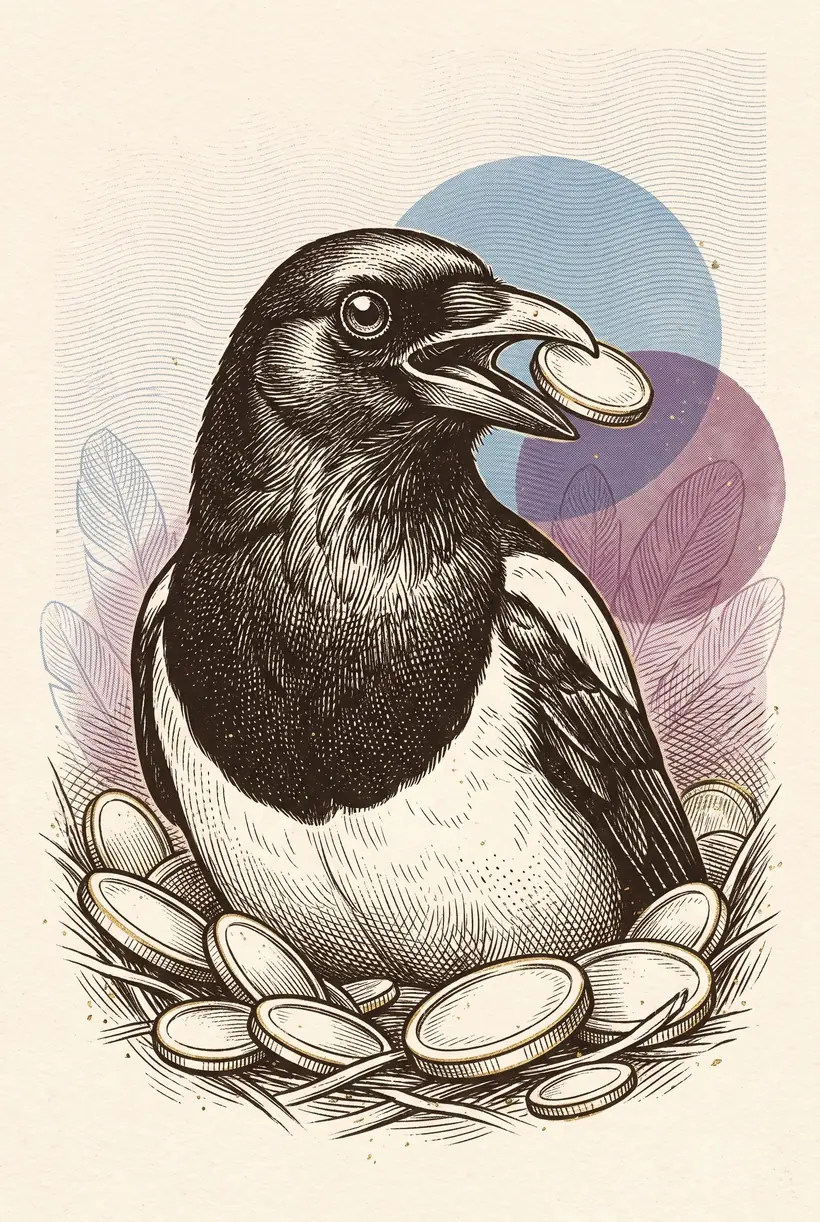
Your money animal
The Magpie
Subscription Collector
The Roast
You've subscribed to becoming a better person six times. Monthly. And you're using zero of them.
The pattern
Subscriptions weaponize inertia — each is small, auto-renewing, and easy to forget; the forgetting is the business model — which is also the good news: one afternoon of remembering claws most of it back.
Line Items
Notices the charges, forgives them monthly.
The Move
The subscription audit: list every recurring charge, cancel one you forgot you had today. One. Right now.
No email needed — they have to guess yours first.
The Weekly Receipt · First Edition · Nº 03 / 12
The Appraisal · common · Nº 03
The Magpie
Subscription Collector
If you sign up for subscriptions you forget to cancel, The Weekly Receipt calls you the Magpie. Collects trials, free-agents on renewals, never cancels.
You've subscribed to becoming a better person six times. Monthly. And you're using zero of them.
Exhibit 01
The pattern underneath
Subscriptions weaponize inertia — each is small, auto-renewing, and easy to forget; the forgetting is the business model — which is also the good news: one afternoon of remembering claws most of it back.
Exhibit 02
Why forgotten subscriptions survive
A subscription is designed around a single fact about you: sooner or later, you will forget. Signing up is one bright, deliberate decision — a free trial, a "fine, it's only $4.99" — and cancelling is an entirely separate decision you'd have to make again every month, unprompted, while nothing on any screen ever nudges you to make it. The charge, meanwhile, renews itself silently in the background whether you're using the thing or not. That asymmetry is the whole business model: one active yes, set against an endless string of passive, invisible ones.
The asymmetry runs on a documented quirk called status-quo bias — whatever is already happening tends to keep happening, because doing nothing is easier than doing something, and "I'll cancel it later" is a task that never actually comes due. Auto-renew weaponizes it deliberately. Each individual charge is small enough that it never trips the flinch a big one-off purchase would, so it slides straight past the part of your brain that questions costs. The forgetting genuinely isn't carelessness on your part; it's the product performing exactly as it was engineered to.
The gap this opens is far wider than people picture, because you're not tracking a total — you're tracking a feeling. Ask most subscribers what they spend and they'll confidently name the two or three services they actually use; the real bill is the quiet graveyard underneath it — the app from a project that ended, the trial that converted while you weren't looking, the service you swapped to but never bothered to cancel. The number lives in a blind spot precisely because no single line item is ever large enough to break the surface and get noticed. Annual billing deepens the fog — a yearly charge lands once, earns one flinch, and is forgotten eleven months before it strikes again — and with charges scattered across two or three cards plus an app store, no single statement ever shows you the whole picture at once.
None of that is a spending problem, which is the genuinely reassuring part. It's an attention problem, and attention problems have a cheap fix that willpower problems don't: you don't have to want less, resist temptation, or feel guilty about anything — you need one honest list, made once. The reason a list works where good intentions keep failing is that it converts a hundred passive, forgotten yeses back into a handful of active, deliberate decisions. That conversion is the exact thing the whole auto-renew machine was built to stop you from ever getting around to.
So the move is to force the moment of attention the system is quietly counting on you to skip. Pull every recurring charge into a single view, cancel the first one you'd clearly already forgotten about today — just one, right now — and put the renewal dates somewhere you'll actually run into them, so "auto" turns back into a choice you get to make on purpose. One unglamorous afternoon of remembering tends to claw back a genuinely surprising chunk of a bill you had simply stopped seeing at all.
The number to know
$86 → $219
People estimate their subscriptions cost about $86 a month; the itemized total averages $219 — roughly 2.5x higher — and nearly 42% admit they’re still paying for a service they’ve stopped using.
Exhibit 03
What the Magpie gets right
Exhibit 04
Your next moves
- The subscription audit: list every recurring charge, cancel one you forgot you had today. One. Right now.
- Put renewals on a calendar so “auto” becomes a decision you actually make.
This is the general read
Want your version — your real score spectrum, your primary + shadow blend, and the tension your own answers reveal? That takes two minutes.
Questions people ask about the Magpie
- Why do I sign up for subscriptions I forget to cancel?
- Subscriptions weaponize inertia — each is small, auto-renewing, and easy to forget; the forgetting is the business model — which is also the good news: one afternoon of remembering claws most of it back.
- Is being the Magpie a bad thing?
- No — it's a pattern, not a verdict. Magpies tend to be curious, early adopter, optimizes for a better life (in theory). The goal isn't to stop being you; it's to manage the one habit that quietly costs you.
- How do I work on being the Magpie?
- The subscription audit: list every recurring charge, cancel one you forgot you had today. One. Right now. Put renewals on a calendar so “auto” becomes a decision you actually make.
Guides for the Magpie
Meet more money animals
Just so we’re clear: The Weekly Receipt is financial education and entertainment, not personalized financial, investment, tax, or legal advice. Your money animal is a fun framework, not a diagnosis. This read and its cited number were reviewed by The Weekly Receipt.